
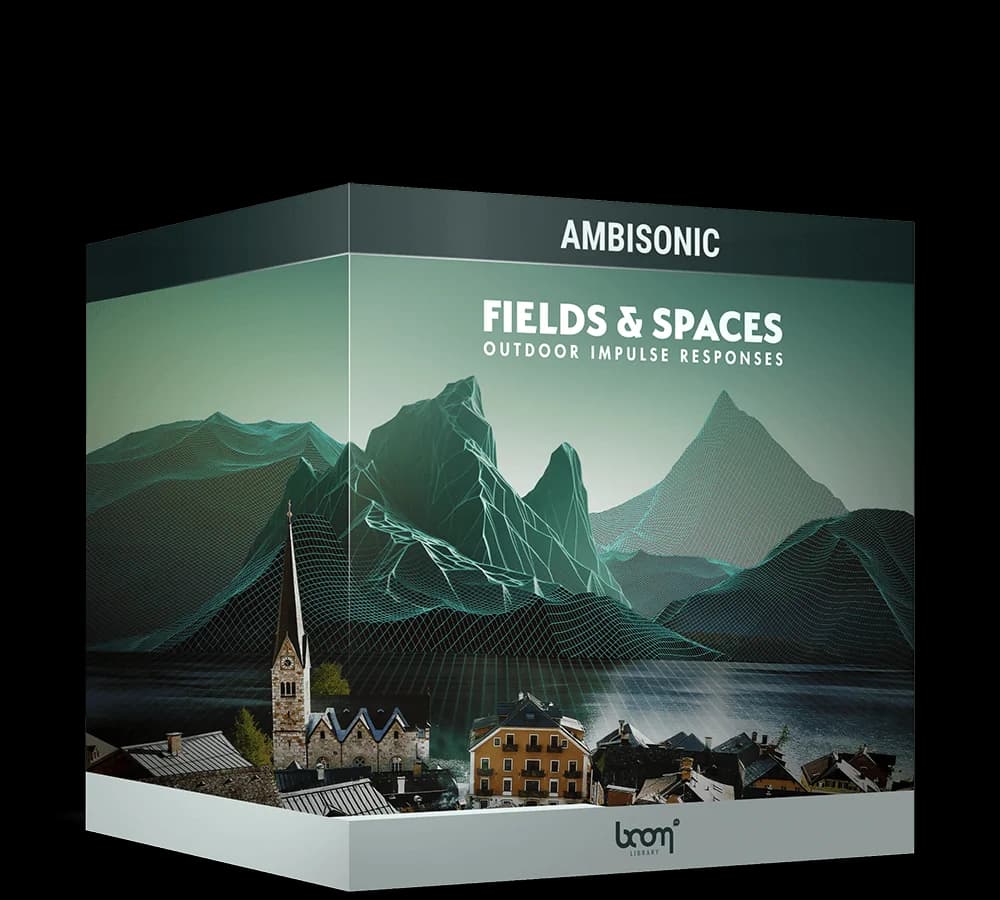
Field & Spaces - Outdoor Impulse Responses
THE PERFECT IMMERSION IN HUGE AND COMPLEX OUTDOOR SPACESBoom Library$289.00
Field & Spaces - Outdoor Impulse Responses - Surround
$229.00
Field & Spaces - Outdoor Impulse Responses - Stereo
$115.00
Nothing here was recorded outdoors. It was modelled.
The field gives the reason plainly: a real outdoor impulse response needs a source loud enough to excite a canyon and weather that will hold still while you use it. After two years of studying how sound behaves on different surfaces, in the supplier’s own words, the reflections were modelled instead — which is also why the copy says no recording noise came with them.
At a Glance
- 123 impulse responses The same figure in all three editions — stereo, surround and ambisonic carry the same set at three widths
- Four natural settings named Canyons, forests, hills and mountains, and the field closes the list with “and more”, so four is what is named rather than what is in there
- Nine urban settings named Bridges, squares, streets, alleys, ports, courtyards, dams, castles and underpasses — also closed with “and more”
- 1.2 GB across 123 IRs About 9.8 MB per impulse response in the stereo edition — the division is computed here
- Distance varies with place A medium canyon at 0, 30, 40 and 70 meters; a long alley at 0, 70 and 120; a forest pit at 0 and 10. Four points, three and two — counted off the field’s three worked examples
- Stereo is a fold-down The field states it: the stereo set is a mix-down of the ambisonic version, and it credits that for the density of the tails
Content & Detail
An impulse response is a space answering one question. Outdoors there is no room to answer — only ground, distance and whatever happens to stand in the way — which is why this set is organised by distance as much as by place, and why a forest pit gets two measuring points where a canyon gets four.
Product Information
Features
Stereo: Impulse Responses 123; Size 1.2 GB
Surround:Impulse Responses 123; Size 7 GB
Ambisonic:Impulse Responses 123; Size 12.1 GB. This pack also includes the Surround and Stereo IR packs.
Downloads
00_Fields_Spaces_OIR_Altiverb_Metadata.pdfContent Info
00_Fields_Spaces_OIR_Altiverb_Metadata.xlsxContent Info
00_Fields_Spaces_OIR_Ambisonic_Metadata.pdfContent Info
00_Fields_Spaces_OIR_Ambisonic_Metadata.xlsxContent Info
00_Fields_Spaces_OIR_Stereo_Metadata.pdfContent Info
00_Fields_Spaces_OIR_Stereo_Metadata.xlsxContent Info
00_Fields_Spaces_OIR_Surround_Metadata.pdfContent Info
00_Fields_Spaces_OIR_Surround_Metadata.xlsxContent Info
00_BOOM-Library-EULA-2022.pdfEULA